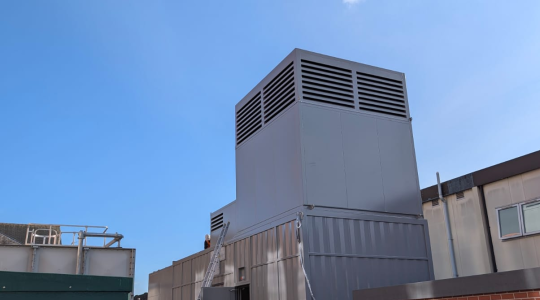
RAF Valley Bunded Waste Oil Tank: A 1,750 Litre Imperium® Project
How Atlantis brought a checkable specification, planned HIAB positioning and old-tank collection into one defined package.
A tank replacement succeeds when the specification, delivery access and removal plan work together.

A bunded waste oil tank may be an unsung site asset, but replacing one calls for precise planning. First, capacity and secondary containment must match the brief. At the same time, the team must settle access, lifting and old-tank removal before delivery day.
For this RAF Valley project, an order associated with Egnitest Limited brought those requirements into one defined package. Specifically, Atlantis Tanks was asked to provide a 1,750 litre steel bunded waste oil tank. The scope also included premium HIAB delivery and collection of the prepared empty tank.
Project at a glance
| Project detail | Recorded scope |
| Site | RAF Valley, Anglesey |
| Project contact | Egnitest Limited |
| Tank | TAN.WOI-1853 Steel Bunded Imperium® Waste Oil Tank |
| Capacity | 1,760 litres nominal; 1,853 litres brimful |
| Footprint | 1,320 mm × 1,320 mm; height 1,250 mm |
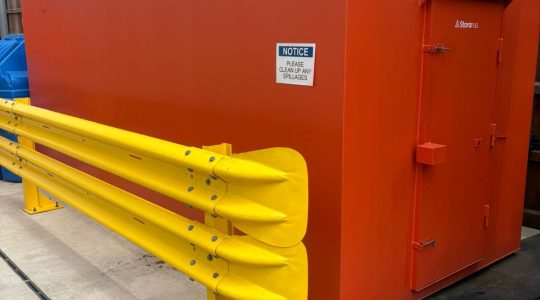
| Containment | Integral outer bund stated to provide 110% secondary containment |
| Logistics | Premium delivery with HIAB offloading and positioning, plus empty-tank collection |
A replacement brief with practical constraints
The outgoing tank could not simply be lifted away without preparation. The collection terms required it to be empty, cut in half and easy to access. It also had to remain available for inspection at the collection point.
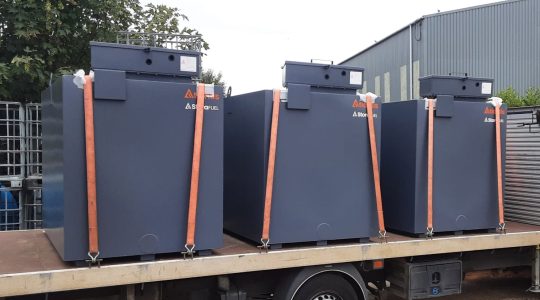
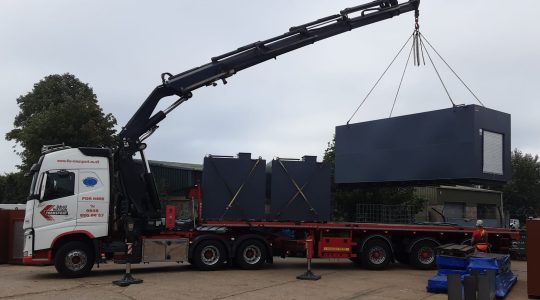
Meanwhile, the replacement tank needed a defined route onto site. Atlantis’s Premium White Glove Delivery Service included an Atlantis vehicle, HIAB offloading and positioning. The delivery date and time could be agreed subject to stock availability.
The selected bunded waste oil tank
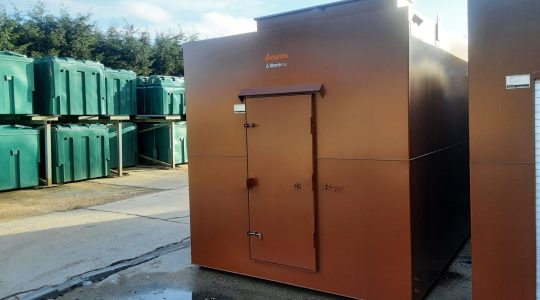
The order specified Atlantis model TAN.WOI-1853. In particular, its 1,320 mm square footprint provides 1,760 litres of nominal capacity. The specification also states that the outer tank provides 110% secondary containment.
The standard waste-oil inlet combines a strainer with a lockable lid. The strainer helps keep unwanted debris out during manual filling. Meanwhile, the lid controls access to the inlet. In addition, a top suction connection supports oil removal through an internal pipe.
The Imperium® fittings plate makes the inspection area easier to reach. Its modular format can also accept compatible future fittings. For example, the optional lockable top box can be added later. These are practical service features, not decorative extras.
A specification that can be checked
Inner dimensions: 1,190 mm long × 1,260 mm wide × 1,248 mm high
Material: S275JR steel to BS EN 10025-2:2004
Construction: stated as made in accordance with BS 799 Part 5, with internal tank bracing
Handling: full-length bearers and lifting eyes for use only when the tank is empty
Standard colour: BS 14 C 39 black
Warranty: 10 years, subject to the applicable terms and registration requirements
Delivery formed part of the solution
The order did not treat transport as an afterthought. HIAB offloading and positioning formed part of the recorded delivery scope. Therefore, the project team could plan access and handover around a defined lifting service.
The collection terms created the same clarity for the outgoing tank. Clear preparation requirements gave each party a stronger basis for planning.
Professional advice includes the limitations
The standard specification uses ST2 surface preparation and a Zinfos 340 WS anti-corrosive coating system. However, Atlantis’s product guidance recommends discussing an alternative coating for a marine environment.
The recorded Anglesey location makes that caveat relevant. For this reason, ignoring it would weaken the story rather than strengthen it.
Bunding and the Welsh regulatory context
Welsh Government guidance explains the Water Resources (Control of Pollution) (Oil Storage) (Wales) Regulations 2016. The rules cover above-ground oil containers over 200 litres, including waste oil. For a single tank, secondary containment must generally hold at least 110% of the maximum contents.
The tank specification states that the outer tank forms an integral 110% bund. However, competent parties must still check the complete installation.
The verified outcome must complete the story
The evidence currently confirms a well-defined order. It does not yet confirm the completed delivery or operational result.
What this project demonstrates
Strong replacement projects align three things: a checkable tank specification, a workable delivery plan and clear removal responsibilities. Capacity matters. So do footprint, lifting limits, inspection access and the suitability of the protective finish.
That is how Atlantis Tanks builds confidence: by making the practical questions visible and defining the supplied scope clearly. This approach helps project teams prepare more thoroughly for delivery day.