How HVO Fuel is Helping a Green Industry Become Even Greener
 It was a delight to meet Nicholsons’ Head of Procurement, Alan Bevan, to talk about his company’s enlightened approach to creating beautiful gardens and landscapes in the most sustainable way possible.
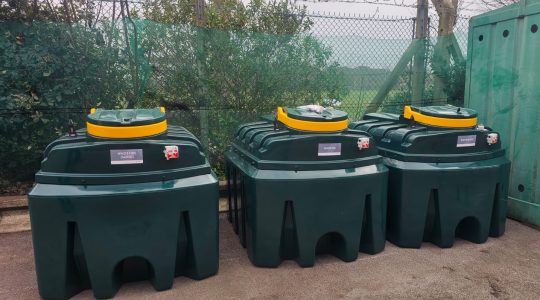
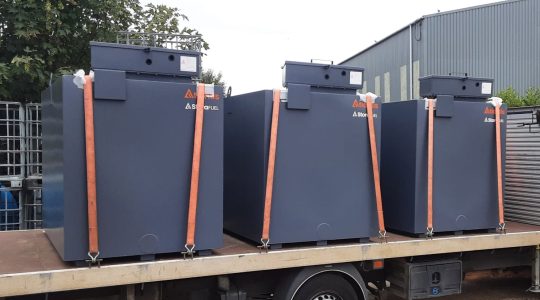
In a routine catch-up call, we were struck by the fact that our client, Nicholsons, was using three of our diesel storage tanks to store and dispense HVO fuel.
Atlantis Tanks were keen to discover how HVO is helping Nicholsons. We share Nicholsons’ unique business perspective on the landscaping business which shaped their decision to swap out fossil diesel with a renewable alternative. We also delve into their real world use of HVO fuel, its advantages, costs and drawbacks too.
Our visit to Nicholsons also reveals a little known HVO benefit which could be of financial significance to commercial vehicle fleet owners and managers.
What is HVO fuel?
HVO is an acronym for Hydrotreated Vegetable Oil. It’s a second generation biofuel steadily gaining in usage. It is designed to be a drop-in replacement for diesel in either blended or pure form.
HVO is manufactured in increasing volume by hydrogenating or hydrocracking of vegetable oil, tallow and waste vegetable biomass. The result is a 100% renewable fuel that can be used in private or commercial vehicles and generators.
The main attraction to using HVO is the reduction in greenhouse gas (GHG) emissions. For biofuels in general, GHG can be 82% lower than fossil fuel usage, according to the UK government’s latest biofuels report.
HVO is particularly beneficial because it achieves a 90% reduction in carbon emissions when compared to regular diesel fuel.
How Nicholsons Evolved into a Leading Sustainable Landscaper

Amazing selection of sustainable, flowering and bedding plants
Nicholsons is led by Managing Director, Liz Nicholson. Her environmental credentials were recently on display delivering Nicholsons green audit at the RHS Chelsea Flower Show in May 2024. She offered all the garden designers positive, tangible suggestions on how each designer could reduce the carbon footprint of their creations and enhance environmental benefits.
The company has become both an ecological thought leader and action taker in the landscaping industry. Their sustainable approach permeates everything they do.
More than Skin Deep
Walking around the yard complex and nursery, it was evident that every area of operations has been examined and changed for a greener solution. It is easy to feel Nicholsons’ devotion and sincerity towards the environment when one can see:
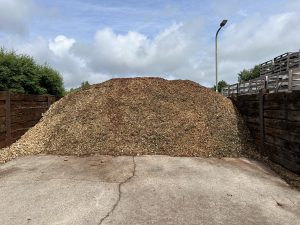
Store of woodchips from forestry division before processing for use as biofuel
- their rainwater harvesting system
- use of wood chip biofuel to heat buildings and greenhouses
- use of solar panels on buildings to the extent that they sell surplus electricity to the grid
- waste management practices on site
Landscaping solutions for customers are also affected. The obvious, visual aspects of garden design are crafted through an environmental lens before being shared with their clients. A wild meadow to improve biodiversity would be advocated over a manicured lawn, for example.
Environmental gains have also been made in less obvious areas of their landscaping work. Reductions in greenhouse gas emissions are made by sourcing low carbon cement and binder when building the hardscaped features of their projects.
There are challenges in ensuring reliable supplies of these lower carbon products, but Alan sees more such materials being stocked as a result of growing demand side pressure.
Nicholsons ‘quiet’ but honest style of environmental advocacy also influences local firm, WHC Hire. This hire firm now only supplies Nicholsons HVO-fuelled machinery. WHC Hire is now Nicholsons’ go-to company when they need extra plant for larger projects.
Do Customers Care for the Environment As Much?

Water lilies helping to filter and clean the water of a natural swimming pool.
Many clients are open to consider a more nature-friendly solution to their landscaping project. Who wouldn’t consider a natural swimming pond that employs fresh water technology instead of a traditional swimming pool which uses harmful chlorine.
Other projects are driven by a declared ecological imperative. In fact, some landscaping bids may only be won if Nicholsons’ proposal includes ways to increase Biodiversity Net Gains (BNG) by a specific percentage. In fact, a 10% uplift of BNG is now a statutory requirement for small land developments. Nicholsons have a well-earned reputation for landscape led design where their team of experienced designers put climate and nature at the forefront of their work.
Does A Sustainable Approach Cost More Money?
Alan says: “Often yes, we could save money by ignoring the environmental aspect. But costs are only half the profitability equation.” Nicholsons’ ‘green’ brand positioning is winning them more business.
Instead of simply ‘greenwashing’ their services in a superficial manner, Nicholsons take a long term view of their business activities and have chosen to be a leader in the landscaping sector.
Why Did Nicholsons Choose HVO Over Diesel?
HVO’s environmental and commercial benefits
Alan Bevan calculated that switching to HVO for most of the vehicle fleet had the biggest and fastest impact on reducing the company’s greenhouse gas emissions. The directors agreed with Alan’s calculations and asked him to proceed with the conversion.
“A single delivery of 20,000 litres of HVO saves up to 90% of carbon emissions.”
This means the Nicholsons vehicle fleet saves c.80,000 kg of CO2 emissions for every 20,000 of HVO used. This is based on the UK Government’s latest conversion factors.
A surprise benefit of HVO
Something that has surprised Alan is that he sees lower maintenance and servicing costs for the majority of the 82 strong fleet. Although this is anecdotal, a number of sources point to HVO’s cleaner burn characteristic with significantly lower exhaust particulates and NOx emissions.
It is entirely reasonable to assume that HVO usage means a lower incidence of unburnt carbon deposits leading to cleaner engine internals. Fossil diesel’s sootier burn leads some to report that HVO reduces AdBlue usage compared to regular diesel.
Costs of Converting a Commercial Fleet to Run on HVO
Even as a climate advocate, Alan acknowledges that it costs 10% to 20% more to fuel Nicholsons fleet with HVO biodiesel compared to regular diesel.
60% of Nicholsons’ fleet of 72 diesel-engined vehicles run entirely on HVO fuel. Their vehicles include road transport, vans, diggers, dumpers and excavators all running on HVO.
Minor drawbacks of using HVO
- Distribution & supply of HVO – According to Alan, this is improving. However, HVO is still not widely available at the pump. This means HVO is
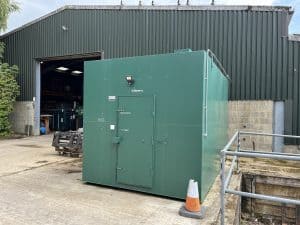
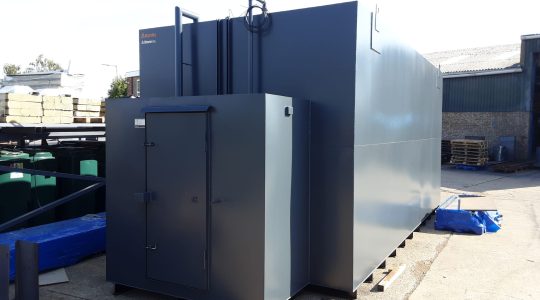
Nicholsons’ 20k Litre diesel tank from Atlantis Tanks being used to store HVO fuel for their vehicle fleet
supplied in bulk by tanker. Here, the minimum economic delivery amount of HVO in bulk is 20,000 litres. This is why Nicholsons purchased a 20,000 litre diesel tank from Atlantis Tanks (pictured). It’s being used to store HVO fuel with “no problems whatsoever”.
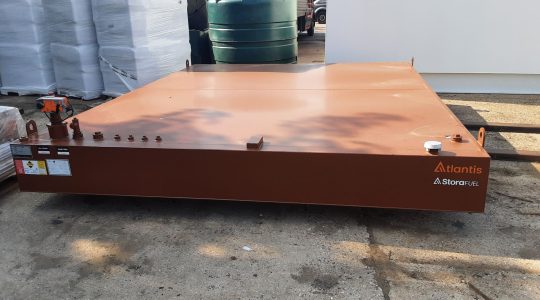
- HVO usage on site – Most of Nicholsons’ landscaping project sites are located far from their yard in Bicester. Unfortunately, a 20,000 litre fuel tank is not very mobile. As a consequence, they decant what HVO they need into portable storage tanks of smaller capacity for remote use. This is why Nicholsons chose a 2000 Litre Portable Steel Bunded Diesel PortaTank from Atlantis Tanks.
According to Alan, fuel distributors such as Speedy Fuel, Watson and Crown Oil are beginning to supply smaller quantities of HVO on ‘remote’ work sites in more manageable 1000 litre and 2000 litre loads. This is helping to improve HVO’s usability in commercial situations, according to Alan.
Atlantis HVO Storage Solutions

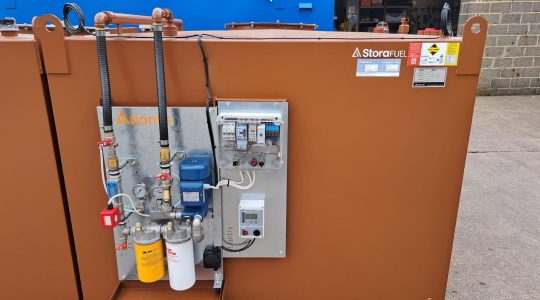
Latest version of the 20000 Litre Steel Bunded HVO Tank by Atlantis Tanks
The latest equivalent of the larger tank that Alan ordered from us is our 20,000 HVO Dispenser (pictured). Click Here for more Information on this HVO Tank.
Information on the whole Atlantis HVO range of bunded steel storage tanks from 1350 litre to 20,000 litre capacities is available here: https://atlantistanks.co.uk/products/portafuel-storafuel/hvo-fuel-dispensers/